Practical Data: Your Growth Strategy Depends on Connecting the Data
 By
By
From the first marketing interaction to a long-term customer relationship, growth depends on connecting what you learn along the way. If the underlying data remains disconnected, increasingly sophisticated marketing technology and AI simply operate on fragments of that relationship.
CMOs are under increasing pressure to find growth in markets that are already crowded, competitive and expensive to penetrate. The response is familiar: improve acquisition efficiency, increase conversion, sharpen targeting, improve retention, identify cross-sell opportunities and use AI to make marketing more precise.
All of those strategies depend on something more fundamental: can your organization connect what it learns about people across every stage of their relationship with you?
Someone may see your advertising, encounter your social content, visit your website several times, respond to an email, research a product, make an enquiry and eventually become a customer. After that, the relationship continues through purchases, digital interactions, service calls and potentially many more opportunities. Each interaction can tell you something. The challenge is connecting the relevant signals so they progressively create a more useful understanding of the person, prospect or customer behind them.
Growth starts before someone becomes a customer
The word customer can itself make this problem sound narrower than it really is. Growth begins long before the first purchase. People may already be interacting with your organization through advertising, social media, campaigns, events, websites and product research without ever having formally identified themselves.
Those interactions are already shaping their perception of your products and services. They can also provide useful signals about interest and intent. The business will not always know who that person is, and privacy, consent and purpose boundaries matter. The objective is not to connect everything. It is to connect the relevant interactions where doing so is appropriate and useful, allowing the organization to build a better understanding of behaviors, interests and needs before a commercial relationship exists.
Once someone becomes a customer, that history does not suddenly become irrelevant. It becomes part of a longer relationship that can inform onboarding, service, retention, cross-sell and future growth.
Growth depends on connecting what you learn about people before, during and after they become customers.
Connected interactions create understanding
A single interaction rarely tells you very much. A website visit may indicate interest. An email response provides another signal. A product enquiry adds more context. A purchase changes the relationship. A service call tells you something else entirely. Repeated behavior over time may reveal preferences that the person has never explicitly stated.
Individually, these are touchpoints. Connected together, they become knowledge. The objective is to build a progressively richer understanding of the person and their relationship with your business: what they have shown interest in, how they behave, what they own, what they prefer, what they have responded to and how that relationship is changing. That accumulated understanding is what allows marketing to improve targeting, reduce irrelevant contact, identify opportunities and make personalization more useful.
Recognition matters, but it is not the end goal
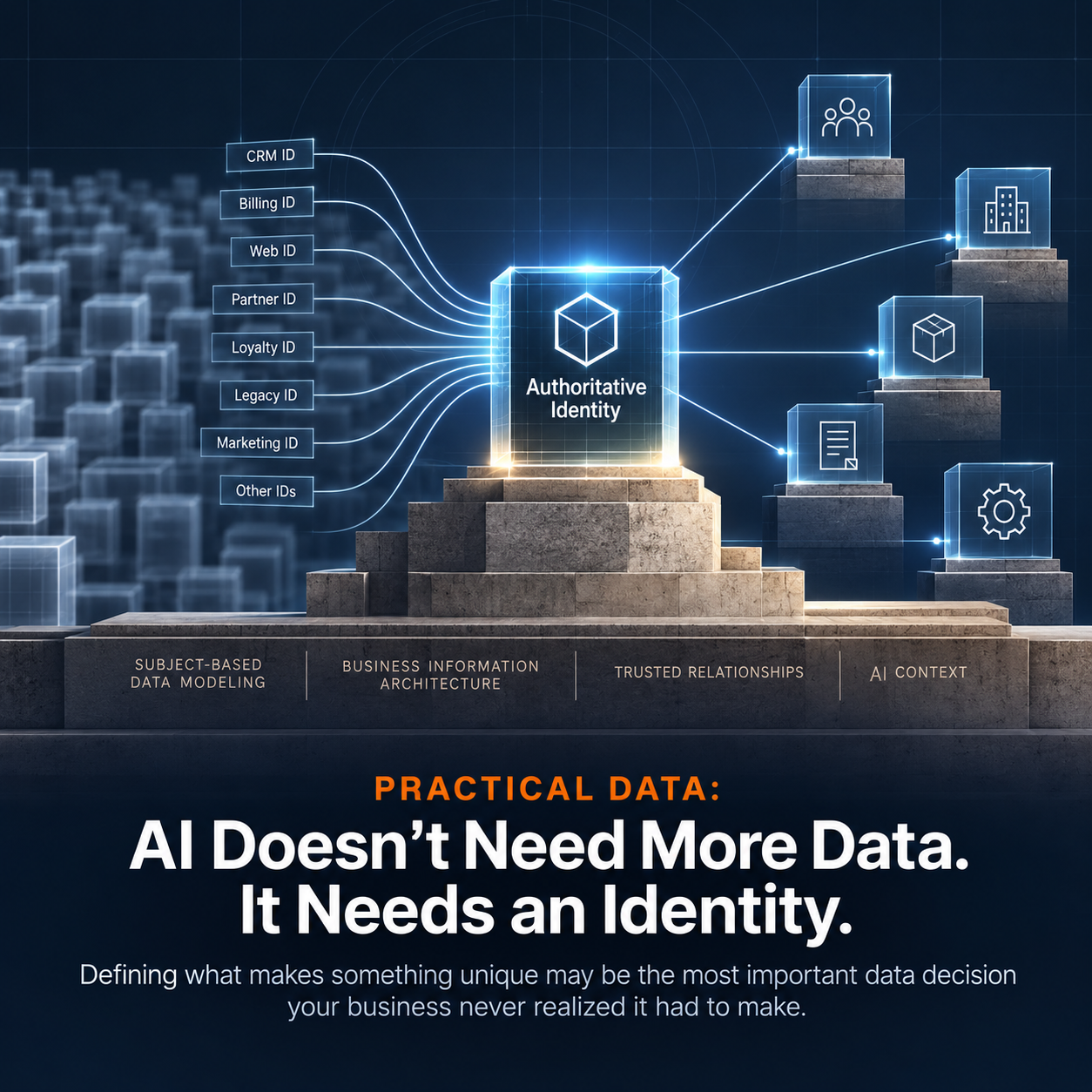
That understanding depends on being able to recognize when different interactions can reasonably be associated with the same person. An email platform, website, advertising platform, CRM, loyalty system and contact center may all know the same person differently.
In data terms, this is identity resolution. For a CMO, the consequence is more important than the terminology: if those interactions cannot be connected with appropriate confidence, different parts of the marketing stack are effectively building different versions of the same prospect or customer. Instead of managing one relationship, the organization is optimizing fragments of it.
From individuals to meaningful groups
Connected information also allows the business to see patterns across people. People with similar behaviors, preferences, needs, product holdings or patterns of interaction can be grouped into meaningful cohorts. Those groups can become increasingly dynamic as the organization learns more, rather than remaining the broad, relatively static segments marketing organizations have traditionally used.
One group may exhibit similar purchasing behavior. Another may repeatedly research the same category of product. Another may show early signs of disengagement. Another may behave similarly to customers who previously purchased an additional product or service.
This is where connected data starts translating directly into growth opportunities. Marketing can increasingly target individuals and cohorts because the organization has accumulated evidence about their interests, behaviors, relationships and likely needs, rather than simply because they appear on a list. That can improve the decisions behind acquisition, conversion, retention and cross-sell while reducing interactions that add cost without adding value.
Connect. Recognize. Understand. Group. Act. Learn.
There is a relatively simple business logic underneath this. Connect the relevant interactions and signals across channels. Recognize when they can reliably be associated with the same person, prospect, account or customer. Understand what the accumulated interactions tell you about behaviors, preferences, products, relationships and needs. Group people into meaningful cohorts. Act on that understanding through acquisition, targeting, personalization, service, retention, cross-sell and opportunity development. Then learn from what happens next.
A response, purchase, change in behavior, ignored offer or interaction through another channel becomes new information. It should improve the next decision. The result is a continuous learning loop rather than a collection of static customer databases.
This is where AI becomes genuinely valuable
AI can dramatically increase what marketing organizations can do with this accumulated understanding. It can identify patterns across large populations, detect behavioral changes, create more dynamic cohorts, identify potential opportunities and help determine which interaction may be most appropriate next. Generative AI can also make individualized content and interactions economically practical at a scale that was previously difficult to achieve.
But this only works if the underlying data is connected. If website, email, social, sales, purchase and contact-center interactions cannot be reliably connected, AI is working with fragments rather than a coherent relationship. More sophisticated algorithms do not compensate for disconnected information.
The CDP problem hiding in plain sight
Customer Data Platforms were intended, in part, to bring customer interactions and identifiers together. But many organizations now have customer-profile capabilities spread throughout the marketing technology stack. CRM, campaign, advertising, digital-experience, personalization, loyalty and customer-service platforms may each maintain their own representation of the same person.
Individually, these technologies may be useful. Collectively, they can create competing versions of the prospect or customer the CMO is trying to acquire, serve and grow.
You cannot buy your way out of disconnected data
Customer understanding is weak, so another platform is purchased. Segmentation is inconsistent, so another audience capability is introduced. Personalization is difficult, so another AI-enabled marketing product is acquired. Interactions cannot be connected, so another customer-data capability is added.
Each purchase may solve a legitimate local problem. But each can also introduce another profile, identifier, set of matching rules and isolated view of the relationship. The result can be higher marketing technology spend without a corresponding improvement in the organization's ability to understand the complete growth journey. Acquisition teams optimize one view, retention teams another, service another, while customers experience one company.
The question therefore remains: can we connect what we know about the people we are trying to acquire, serve and grow well enough to make better commercial decisions? If not, another marketing tool is unlikely to be the answer.
Connected data is a business capability
The technology matters, but the capability should not belong to a particular platform. The business needs to determine which interactions matter, how information should be connected, when different records can reasonably be treated as representing the same person, what level of confidence is required and how that information can appropriately be used across channels.
Technology can implement those decisions. It should not make them by accident.
For the CMO, this affects much more than the quality of a customer profile. It affects acquisition efficiency, conversion, contact strategy, marketing effectiveness, personalization, retention, cross-sell and the ability to identify new growth opportunities. When each platform operates on a different understanding of the relationship, marketing investment is being optimized against incomplete information.
Start with the growth journey, not another platform
Before investing in another personalization platform, CDP or AI capability, executives should ask whether the existing environment can connect the important interactions across major channels, recognize the same prospect or customer with appropriate confidence, use each interaction to improve what is known, identify meaningful groups and opportunities, act consistently and learn from the response.
If the answers vary significantly depending on which platform or business team you ask, the opportunity may not be another tool. It may be to establish a common connected data foundation underneath the tools you already have.
Growth depends on connected data
The opportunity is much larger than producing a cleaner customer database. Connected interactions create richer understanding. Better understanding supports better audience and opportunity decisions. Those decisions create more relevant interactions, and every new interaction provides information that can improve the next decision.
AI can make that cycle faster, more sophisticated and increasingly individualized, but it cannot manufacture the underlying connections if the organization continues to operate on fragmented data.
For the CMO, the executive decision is whether the organization can connect what it learns about people throughout the growth journey well enough to manage the relationship as a whole. Without that foundation, continued investment in marketing technology and AI risks optimizing increasingly sophisticated fragments. With it, every relevant interaction can contribute to better acquisition, stronger relationships and future growth.
Find Out More
Connecting data across your growth journey is only one part of the opportunity. The same principle applies across your business.
A Data Core creates a connected foundation for the critical information your organization depends on—customers, prospects, products, accounts, organizations, transactions and the relationships between them—so trusted information can be consistently used across operations, analytics and AI.
M&A Operating System helps organizations simplify fragmented data environments and create connected information foundations designed around the business outcomes they need to achieve.
Find out more about creating a connected Data Core that can support your entire business at maoperatingsystem.com, or contact us at cdao-advisory@maoperatingsystem.com.